
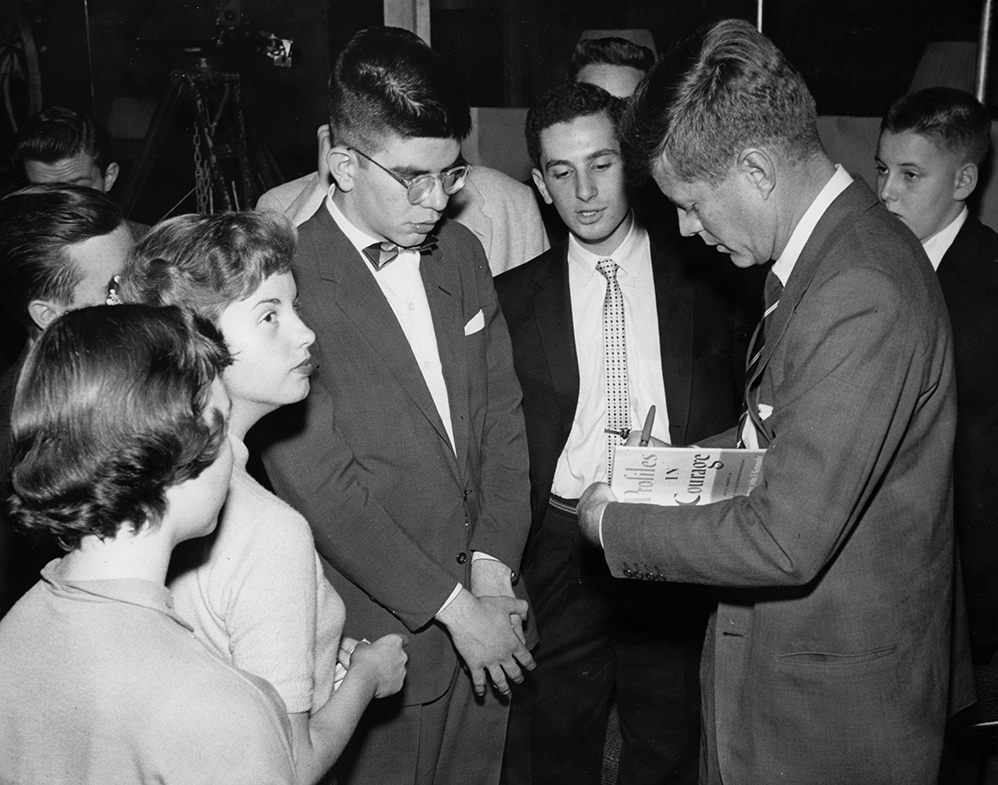
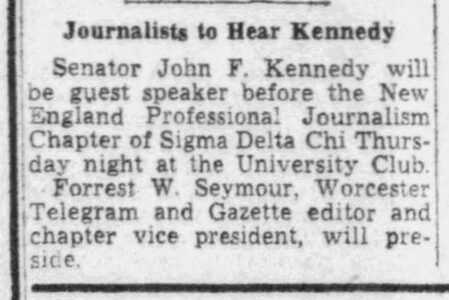
On Oct. 27, 1955, Sen. John F. Kennedy spoke about his philosophy on representative government to an audience of “practically all working newspaper editors” at a Sigma Delta Chi fraternity dinner in Boston.
The future president gave the speech to answer criticism he received for his support of construction in the St. Lawrence Seaway, but he also invoked examples of other senators who had shown courage by putting their own judgment before their constituents. Echoes of the speech would reverberate two months later in his Pulitzer Prize winning book, “Profiles in Courage.”
“Profiles in Courage contains concepts and themes that JFK had articulated in various speeches over the years, really going back to his initial run for Congress in 1946,” said historian Fredrik Logevall, a Harvard University professor and the author of “JFK: Coming of Age in the American Century, 1917–1956.”
“Indeed, one can go back still farther: there are connections between Profiles and his senior-thesis-turned-book, Why England Slept, regarding the challenges of democratic leadership,” Logevall said.
The 1955 dinner was hosted at the University Club in Boston’s Back Bay neighborhood by Forrest W. Seymour, the vice president of the organization now called SPJ New England. The speech is among Kennedy’s pre-presidential papers at the John F. Kennedy Presidential Library.
The nature of a senator’s relationship with his constituents is “one of those facets of legislative government which is of fundamental importance not only to members of the Senate but also to members of the newspaper profession,” Kennedy said. “I cannot believe that the people of Massachusetts sent me to Washington to serve merely as a seismograph to record the ups and downs of popular opinion.”
The St. Lawrence Seaway project allowed marine traffic from the Atlantic Ocean into the Great Lakes and “was bitterly opposed by many local interests which feared that they would suffer from its competition,” The New York Times reported in 1963.
“Others informed me that, in order to be properly responsive to the will of my constituents under our democratic system, it was my duty to place their principles – not mine – above all else,” Kennedy said. He quoted from an editorial that said he was “ruining New England” and “sacrificing the best interests of the people who elected him for the national interest.”
“I believe instead that those of us in public office were elected – not because the people believed we would be bound by their every impulse… but because they had confidence in our judgment, and in our ability to exercise that judgment from a position where we could determine what were the best interests of the voters as a part of the best interests of the nation,” Kennedy said. “Who would be left to look out for the national interest if every Senator were dominated completely by local interests and pressures?”
A year before the speech, Kennedy began a project “to study the topic of political courage” during a leave of absence from the Senate while he recovered from back surgery, according to the JFK Library. That project led to the publication of “Profiles in Courage” in January 1956.
An archivist with the JFK Library said they were unable to “locate any documents that might directly make a connection between the October 27, 1955 speech and Profiles in Courage.” In an online listing for a partial handwritten manuscript of the speech, the Argosy Book Store wrote that “It is likely that the 1955 speech later fed into material used in Profiles in Courage as there are many similarities between the two texts.”
In the speech, Kennedy invoked examples of other senators who had shown courage by putting their own judgment before their constituents.
First, he described the courage of Sen. Lucius Lamar, who “was met with bitter hostility” when he returned to Mississippi after he – among other complaints – “violated the instructions of his State Legislature and ignored the wishes of his constituents by opposing the free silver movement which sought to promote easy, inflationary money for the relief of Mississippi and other debtor and depression-ridden states,” Kennedy said.
He next turned to Massachusetts Sen. John Quincy Adams, who resigned from the Senate after he “acted directly contrary to the interests of his State as well as his party when he steered Jefferson’s Embargo bill against Britain through the Senate,” Kennedy said. “Your predecessors, the Massachusetts newspapers of the day, had a hand in his downfall.”
Finally, he spoke of “another Massachusetts Senator, probably the most famous in our history,” Daniel Webster, who “helped hold together the Union” for 11 years by supporting Sen. Henry Clay’s Great Compromise of 1850. “But Webster had been required to support features of the Compromise which were odious to the people of Massachusetts – particularly the provisions for strengthening the law that required the return of fugitive slaves to their Southern masters,” Kennedy said.
“That remarkable collection of literary lights who gathered in Massachusetts in the mid-nineteenth century condemned Webster in terms which few other Senators have been forced to endure,” Kennedy said. “Once again, the newspapers of our State condemned their Senator for failing to express the views of Massachusetts.”
All three of those stories were retold in “Profiles in Courage.” Adams formed the basis of Chapter 2, Webster of Chapter 3, and Lamar of Chapter 7.
The speech also previewed Kennedy’s description of the sources of pressure a senator faces. The speech describes five – compromise, party, comradeship, reelection and constituency – which would appear in substantially the same language in the preface of “Profiles in Courage.” In the book, Kennedy combined the first three pressures into one, framed as the desire to be liked.
Speaking about comradeship, Kennedy said senators “desire to continue the comradeship and approval of our colleagues in the Senate, to get along with our fellow members of the club rather than pursue a unique and independent course which would embarrass or irritate them.”
The book expands on this idea, reusing it largely verbatim: “We enjoy the comradeship and approval of our friends and colleagues… we are anxious to get along with our fellow legislators, our fellow members of the club, to abide by the club-house rules and patterns, not to pursue a unique and independent course which would embarrass or irritate the other members,” Kennedy wrote.
One anecdote on the topic appears completely unchanged in both works. “‘The way to get along,’ I was told when I entered Congress, ‘is to go along.’”
When describing “the pressure to be reelected,” Kennedy said it “is not a wholly selfish motive – for those who go down to defeat in the hopeless defense of a single principle will not return to fight for that or any other principle in the future.”
He again expanded the same phrasing when writing “Profiles in Courage,” with minor revisions. “It should not automatically be assumed that this is a wholly selfish motive — although it is not unnatural that these who have chosen politics as their profession should seek to continue their careers — for Senators who go down to defeat in a vain defense of a single principle will not be on hand to fight for that or any other principle in the future,” Kennedy wrote.
“Finally, of course, is the pressure which embraces all other pressures – the pressure of a Senator’s constituency, the interest groups, the organized letter-writers, as you know, even the newspapers,” Kennedy said in the speech. Much of this phrasing, too, is repeated in the book – though the reference to his audience of newspaper editors would be replaced with “the economic blocs and even the average voter.”
Kennedy also used the same quote, of California Congressman John Groarty, in both: “One of the countless drawbacks of being in Congress is that I am compelled to receive impertinent letters from a jackass like you, in which you say I promised to have the Sierra Madre mountains reforested and I have been in Congress two months and haven’t done it. Will you please take two running jumps and go to hell.”
